
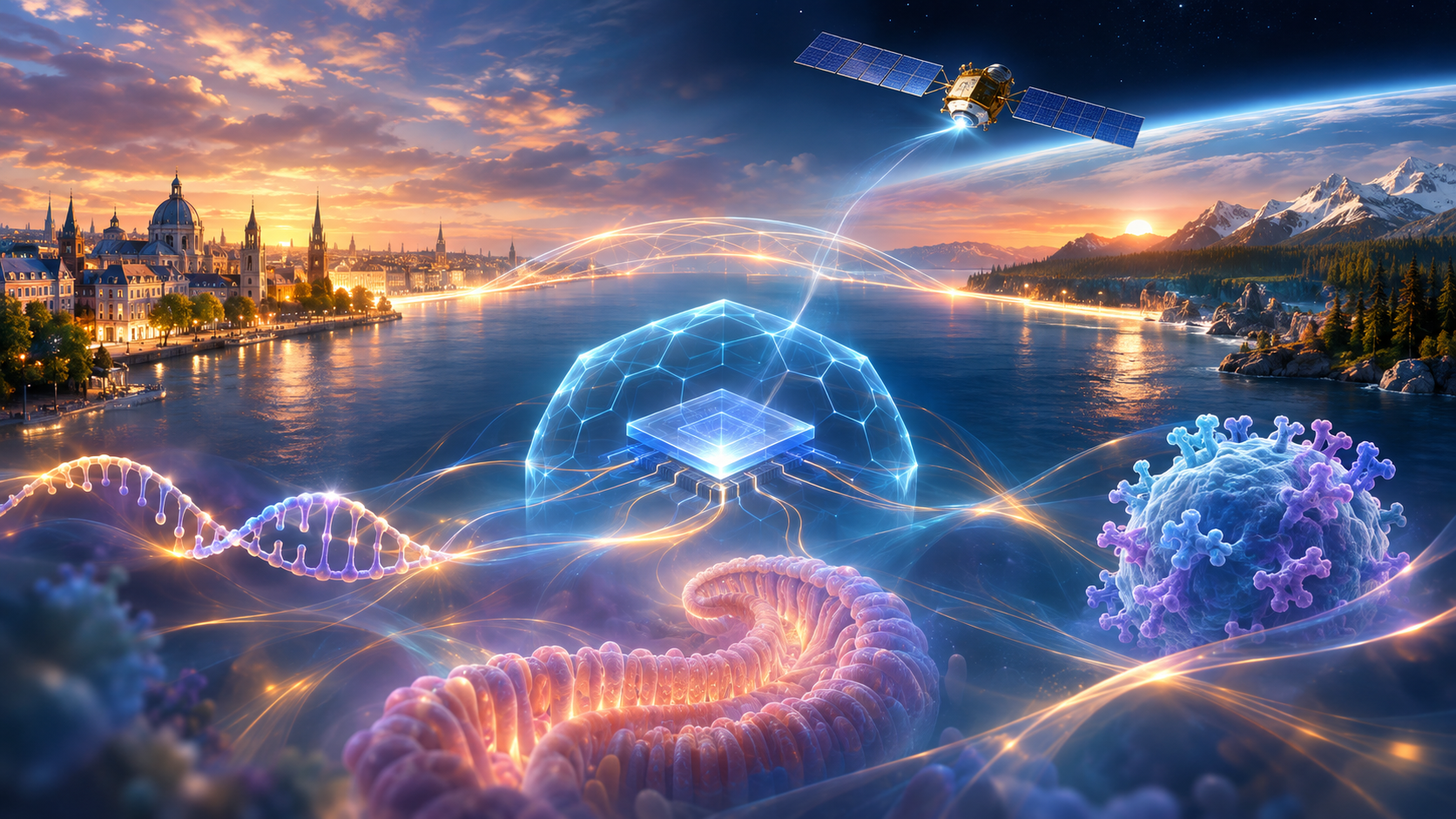
AI Gets Cheaper, Intelligence Reaches Orbit, and Biology Learns to Remember
November 2, 2026 | Reporting on October 26 – November 1, 2026
Good morning, everyone!
Another Monday, another week in which the future seems determined to make itself impossible to ignore.
We have a new generation of AI models becoming more capable and considerably cheaper to operate. Google has successfully demonstrated AI inference on a data-centre-class processor in orbit. And scientists are discovering that our own biological cells may remember previous injuries and use those experiences to improve future repair.
Meanwhile, Canada and the European Union are building a new strategic partnership in a world where access to energy, computing power and critical technologies is increasingly becoming a question of sovereignty.
Seven developments, one recurring theme: progress doesn’t happen in isolation.
And when different technologies begin accelerating one another, things can get interesting remarkably quickly.
Let’s explore!
International Politics
Canada and Europe Build an Alliance for the Future
October 30 | Montréal, Canada
Canada and the European Union officially launched their Alliance for the Future, an ambitious partnership intended to strengthen economic security, trade, defence cooperation and technological competitiveness.
At their Montréal summit, Canadian Prime Minister Mark Carney met European Commission President Ursula von der Leyen and European Council President António Costa.
The announcements included the conclusion of substantive negotiations on a digital trade agreement, closer cooperation on critical minerals, and Canadian participation in the European High Performance Computing Joint Undertaking.
That final development particularly caught my attention.
Access to advanced computing is rapidly becoming as strategically important as access to energy and industrial production.
Countries that depend entirely on foreign suppliers for semiconductors, computing infrastructure, energy or critical materials are potentially leaving important parts of their economic future in somebody else’s hands.
But strategic independence doesn’t necessarily mean isolation.
In fact, cooperation between reliable partners can be one of the most effective ways to reduce dangerous dependencies.
Of course, political announcements are not the same as completed agreements. Several initiatives still require implementation, and not every proposed area of cooperation has a final legal framework.
My main concern is whether these ambitions will translate into actual competitiveness, investment and fewer obstacles for businesses.
Europe doesn’t need another mountain of paperwork dressed up as progress.
It needs an environment in which innovation can flourish.
What to watch: Implementation of the digital trade agreement, Canadian participation in European computing infrastructure, and concrete investment in critical supply chains.
Sources: Canada–EU Joint Statement, October 30 and Government of Canada backgrounder.
Artificial Intelligence & Technology
1. GPT-6.1 Terra: More Intelligence for Less Money
October 26 | OpenAI
OpenAI introduced GPT-6.1 Terra, its latest efficiency-focused model designed for visual reasoning, computer use and professional work.
According to OpenAI, Terra substantially improves upon GPT-5.6 Terra while cutting standard API prices by 50%.
The company also reports that Terra approaches GPT-6 Astra’s performance on certain computer-use benchmarks at approximately one-tenth of Astra’s per-token price.
Terra is available through the API, ChatGPT Work and Codex, rather than ordinary Chat conversations.
Now, here’s why I find this important.
AI progress is often measured by how much more capable the next frontier model becomes.
But the cost of intelligence matters just as much.
An exceptionally capable model that only a handful of organisations can afford to operate is useful. A model that approaches those capabilities at a fraction of the cost can potentially transform entire industries.
Imagine thousands of specialised agents working on research, engineering, administration and creative projects without requiring enormous computing budgets for every task.
The productivity implications could be substantial.
Naturally, benchmark results don’t guarantee identical performance in every real-world application. Complex scientific reasoning and demanding coding tasks may still require more capable models.
Nevertheless, making advanced intelligence cheaper and faster is an important form of progress in its own right.
What to watch: Independent computer-use evaluations and the practical cost of completing entire workflows, rather than merely comparing token prices.
Source: OpenAI: Introducing GPT-6.1 Terra.
2. Gemini 4 Carbon: The Cybersecurity Frontier Accelerates
October 28 | Google DeepMind
Google unveiled Gemini 4 Carbon, a new frontier model focused heavily on cybersecurity, software engineering and long-running agentic tasks.
Google reports that Carbon leads version 5.0 of the Artificial Analysis Intelligence Index, while achieving 88.2% on SEC-bench Pro for vulnerability discovery and 71.0% on CWE-bench for software patching.
The company also describes internal engineering tasks in which Carbon continued working for days, investigating difficult bugs and exploring alternative approaches.
Initial access is restricted to selected cybersecurity defenders through Google’s Fairwind Program.
This raises an increasingly important question.
What happens when intelligent systems become highly capable at both identifying and exploiting software vulnerabilities?
The same capabilities that help defenders discover weaknesses can potentially help attackers exploit them.
That is why cybersecurity is becoming one of the most consequential areas of frontier AI development.
But I also see enormous potential.
Software security remains a persistent challenge. Intelligent systems capable of systematically investigating vulnerabilities, proposing patches and verifying their effectiveness could help make digital infrastructure substantially more resilient.
We should welcome those possibilities without pretending that stronger capabilities automatically produce safer outcomes.
The benchmark figures are Google’s reported results, not proof that Carbon will outperform alternatives in every operational environment.
What to watch: Independent security testing, staged-access outcomes and whether improvements in vulnerability detection translate into reliable remediation.
Source: Google DeepMind: Gemini 4 Carbon, October 28.
3. AI in Space: Google’s Project Suncatcher Reaches Its First Milestone
October 30 | Google Research
This may be my favourite technology story of the week.
Google announced that its Project Suncatcher prototype satellite had successfully returned an AI-generated response from a data-centre-class TPU operating in orbit.
The satellite launched on October 1. Following initial commissioning and machine-learning tests, engineers sent a prompt to an onboard Gemma 4 model.
The processor generated a short poem about being in space, which was transmitted back to Earth as the satellite passed near Svalbard.
It sounds almost charmingly simple.
A processor in space writing poetry.
But the implications are considerably larger.
Project Suncatcher is exploring whether future AI computing infrastructure could operate in orbit, potentially taking advantage of abundant solar energy.
For anyone interested in the long-term future of computing, this is a fascinating experiment.
However, one successful inference is not evidence that orbital data centres are already commercially practical.
Radiation exposure, thermal management, launch costs, communications bandwidth and maintenance remain enormous challenges.
Google’s next planned investigations include testing processor reliability under orbital conditions and eventually operating interconnected satellites.
Nevertheless, the first functioning prototype represents a tangible engineering milestone.
We have spent decades imagining enormous computational infrastructure extending beyond Earth.
And now we have an early experiment testing pieces of that possibility.
Welcome to the future, Dorothy.
We’re definitely not in Kansas anymore.
What to watch: Thermal and radiation testing, processor reliability and Google’s planned two-satellite experiments in 2027.
Source: Google Research: Project Suncatcher, October 30.
Science & Medicine
1. Scientists Discover That Intestinal Cells Remember Previous Injuries
October 27 | Nature Communications
Researchers published fascinating findings suggesting that intestinal stem cells can retain a form of biological memory after injury.
Using mouse models and intestinal organoids, the scientists discovered that inflammation and tissue regeneration can produce lasting changes in gene activity and chromatin organisation.
These changes appear to prepare the tissue for a more effective response to subsequent injuries.
The researchers identified interferon-gamma signalling as an important contributor to this regenerative priming.
This isn’t memory in the way our brains remember experiences.
It’s an epigenetic and transcriptional imprint that influences how cells behave when challenged again.
And that’s precisely why I find it so interesting.
We often think of tissue repair as a process that restores something to its previous condition.
But what if the experience of injury also changes how tissue responds in the future?
Understanding these mechanisms could eventually contribute to regenerative medicine and treatments for inflammatory disease.
There is an important caution here: persistent inflammatory programming may have harmful consequences too, and these results come from preclinical experimental systems.
This isn’t a treatment for human ageing.
But it provides another glimpse into the sophisticated biological mechanisms that maintain and repair living organisms.
What to watch: Validation in human tissues and whether regenerative memory can be safely influenced without encouraging chronic inflammation or abnormal growth.
Source: Nature Communications: October 27.
2. RNA Editing Without Permanently Changing DNA
October 28 | Nature Methods
Researchers introduced MARRS, a new RNA-editing platform that recruits cells’ own ADAR1 enzymes.
Rather than permanently changing the DNA sequence, the technique modifies RNA molecules, potentially allowing certain genetic errors to be corrected at the transcript level.
The researchers reported editing efficiencies reaching 100% under particular laboratory conditions and up to 84% in mouse experiments.
Those are impressive experimental figures.
What makes RNA editing particularly interesting is its potentially reversible character.
DNA editing changes the underlying genetic instructions. RNA editing can instead modify the messages produced from those instructions.
That distinction may offer advantages for certain future therapies, although repeated treatment could be necessary and delivery remains a major challenge.
The researchers also reported promising specificity, but that does not establish safety in humans.
We should not confuse successful editing in cells and animals with an approved treatment.
Nevertheless, the expanding precision of genetic and molecular technologies offers increasingly fascinating possibilities for medicine.
What to watch: Delivery methods, long-term effects, off-target editing and eventual studies in disease-relevant human systems.
Source: Nature Methods: October 28.
3. Machine Learning Helps Map the Surface of Human Immune Cells
October 28 | Nature Structural & Molecular Biology
Researchers created a large-scale nanoscale map showing how proteins are organised across the surface of human immune cells.
Using proximity labelling, mass spectrometry and machine learning, they investigated spatial relationships among proteins associated with 85 targeted antigens.
The resulting map revealed both familiar molecular structures and previously underappreciated associations.
One finding linked the IL-10 receptor beta subunit to regulation of type I interferon signalling.
Why does that matter?
Because cellular biology isn’t simply about identifying which molecules exist.
Their location, interactions and organisation can be equally important.
Understanding these relationships could help scientists investigate immune signalling, disease processes and possible future therapeutic targets.
The machine-learning component is particularly interesting because it helped researchers prioritise protein associations for further investigation.
That is an increasingly important application of AI in science.
Not replacing researchers, but helping them navigate enormous quantities of biological information and identify relationships worth testing.
The study provides a research resource, not a demonstrated new treatment.
Still, tools like this may eventually help researchers understand biological systems at a level of detail that would have been extraordinarily difficult to achieve before.
What to watch: Independent replication, functional studies of newly identified interactions and whether this mapping approach can be expanded across other human cell types.
Source: Nature Structural & Molecular Biology: October 28.
Final Thoughts: Progress Is Becoming a Connected System
What fascinates me about this week’s developments is not simply that we’re making better AI models, or discovering new mechanisms in biology.
It’s that the boundaries between different fields are becoming increasingly blurred.
More efficient computing enables more sophisticated agents. Better agents help researchers analyse difficult problems. New scientific discoveries create opportunities for new technologies.
And those technologies, in turn, provide even more powerful tools for discovery.
It’s a cycle of progress that can reinforce itself.
Of course, none of this guarantees AGI, Super Intelligence or a technological singularity on any particular timetable.
And there are still enormous scientific, economic and engineering obstacles ahead.
But the direction of travel is extraordinary.
I don’t believe progress should be recklessly pursued without responsibility. Nor do I believe we should artificially halt meaningful advances simply because change makes us uncomfortable.
We need the courage to explore, the discipline to investigate and the wisdom to adapt.
After all, we’re not passengers in some predetermined future.
We’re among its builders.
Have a wonderful Monday, everyone!
Never doom, always bloom.
Melissa Kampers